
Tsukimi de ippai: moon viewing with sake
Last updated
Tsukimi de ippai (月見で一杯, “a drink at the moon viewing”, also called tsukimi-zake) is the Moon of August and the Sake cup of September. The two cards score 5 points, here and under Nintendo’s rules. Because the Moon is also a light and the cup also makes Hanami de ippai, the same few cards can score Tsukimi and several other yaku at once.

Moon芒に月August · Light (hikari) · 20 pts 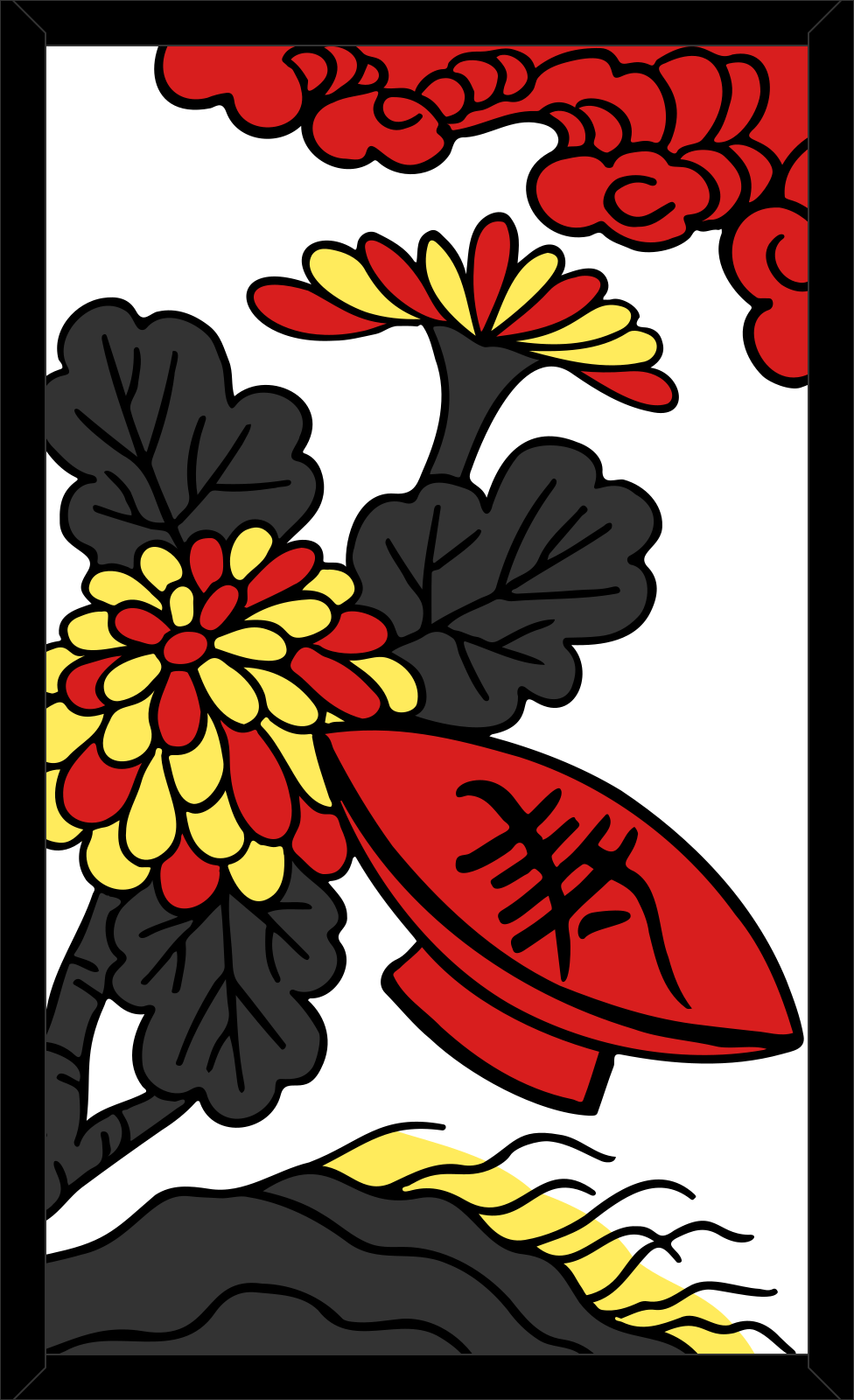
Sake cup菊に盃September · Animal (tane) · 10 pts
The two cards
| Card | Month · flower | Also counts for |
|---|---|---|
| Moon芒に月susuki ni tsuki | August · PampasLight (hikari) | Sankō, Shikō, Ame Shikō, Gokō |
| Sake cup菊に盃kiku ni sakazuki | September · ChrysanthemumAnimal (tane) | Hanami de ippai, Tane; +1 to Inoshikachō |
The August suit is the Moon, the Geese and two plains, with no tanzaku; September is the Sake cup, a blue tanzaku and two plains. The Geese fly over the same hill as the Moon, but only the Moon counts for Tsukimi. It is also one of the five lights, and the Sake cup is a tane (animal card).
Points here and under Nintendo’s rules
Tsukimi de ippai is worth 5 points in this game and in Nintendo’s published Koi-Koi table[1], and on its own it does not double. Two rules make the totals differ once other cards join it: Nintendo doubles from 7 points where this game doubles from 8, and Nintendo also counts the Sake cup as a plain[1].
| Captured cards | This game | Nintendo’s rules |
|---|---|---|
| Moon, Sake cup | Tsukimi 55 pts | Tsukimi 55 pts |
| Moon, Sake cup, Curtain | Hanami 5 + Tsukimi 510 × 2 = 20 pts | Hanami 5 + Tsukimi 510 × 2 = 20 pts |
| Moon, Sake cup, Crane, Curtain | Sankō 5 + Hanami 5 + Tsukimi 515 × 2 = 30 pts | Sankō 5 + Hanami 5 + Tsukimi 515 × 2 = 30 pts |
| Moon, Sake cup and the three red poem tanzaku | Tsukimi 5 + Akatan 510 × 2 = 20 pts | Tsukimi 5 + Akatan 510 × 2 = 20 pts |
| Moon, Sake cup and ten plains | Tsukimi 5 + Kasu 16 pts | Tsukimi 5 + Kasu 27 × 2 = 14 pts |
Tsukimi, Hanami and the light yaku
Tsukimi adds up with every other yaku, and its two cards each belong to more. The Moon is one of the four lights of Sankō and Shikō, and the cup makes Hanami de ippai with the Curtain. So four cards can hold three yaku: the Crane, the Curtain, the Moon and the Sake cup make Sankō 5 + Hanami 5 + Tsukimi 5, so 15 × 2 = 30. With the Rain, the Crane and the Phoenix instead, the Moon and the cup make Ame Shikō 7 + Tsukimi 5: 12 × 2 = 24.
Only the best light yaku counts (see the light yaku), but Tsukimi is never replaced: it adds to any of them.
Tsukimi and the koi-koi call
With Tsukimi made you choose, as with any new yaku, to stop and take 5 or to call koi-koi. Each call by either player adds one to the round’s multiplier: Tsukimi alone pays 5 × 2 = 10 after one call, and 5 × 3 = 15 if you and your opponent have called once each. The multiplier goes to whoever wins, so a round with calls on both sides raises the stakes for both. Adding the Curtain to Tsukimi after one call gives 10 × 2 × 2 = 40.
The Moon: moon viewing and the “shaven head”
A white full moon rises over a hill of pampas grass (susuki) against a red sky: the moon viewing of the fifteenth night of the eighth month (jūgoya), when pampas is set out for the moon. In the old calendar the eighth month fell around September, and pampas is one of the seven flowers of autumn[8].
The black hill has a story of its own. When cards were printed by hand, ink clogged the fine grass on the printing block and left a solid black hill, which looked like a shaven head; so the Moon card is nicknamed bōzu, from a monk’s shaven head[8][7]. It is also called yama ni tsuki, “moon over the mountain”[7], and the card maker Ōishi Tengudō mentions a hill in northern Kyoto, north of Kinkaku-ji, once known as the “bald mountain”, that is said to have been its model[8]. See also the glossary.
The Sake cup beside it stands for the chrysanthemum festival of the ninth day of the ninth month, with sake drunk for long life; its story is on the Hanami de ippai page.
Playing for Tsukimi de ippai
- The Sake cup decides both sake yaku. Only the player who captures it can make Tsukimi or Hanami this round, so taking it also blocks two of your opponent’s yaku.
- The Moon is wanted twice. A player collecting lights needs it as much as one after Tsukimi, so taking it can block both plans at once.
- Mind how cards reach the table. If you hold the Moon and no August card lies on the table, playing it leaves it there for the next August card, which may be your opponent’s (how matching works).
- Use the hints. With assisted highlighting on, a capture that would complete the yaku says so, such as “Completes Tsukimi, +5 pts”. Hover over or tap a captured card to see its owner’s progress, such as “Tsukimi 1/2”.
House rules: fog, rain and nomi
- Kiri-nagare, “fogged out”: while a paulownia (kiri) card lies on the table, chilly fog spoils Tsukimi until someone captures it[3].
- Rain spoils it too in some rules (ame-nagare). Ōishi Tengudō writes that the moon-viewing yaku vanishes if there is a willow card[8]; on Board Game Arena, a player who captures a November card cannot score either sake yaku that round[4].
- Nomi: the Moon, the Curtain and the Sake cup form one yaku worth 10 (or 6) in place of Tsukimi and Hanami[5][2].
- Some rules leave both sake yaku out or value them at 3[2]; others count them only beside another yaku[3].
- The Sake cup counts as a tane or a plain but not both, or only as a tane[3], which is what this game does.
- In Hana-awase Tsukimi de ippai is worth 20 and is also called tsukimi no nomi[6].
This game always counts Tsukimi de ippai at 5 points, and no room setting changes it. The house rules page compares these rules.
Questions
Do the Geese count for Tsukimi de ippai?
No. Only the Moon and the Sake cup do. The Geese are August’s animal card: they count for Tane and add a point to Inoshikachō.
Does a paulownia or willow card cancel it here?
No. Fog and rain rules are house rules, and this game counts Tsukimi de ippai whatever cards lie on the table.
Sources
- こいこい|花札の歴史・遊びかた. Nintendo: Yaku values, the Sake cup as a plain, the 7-point doubling, the koi-koi rule
- こいこい. Wikipedia (Japanese): Common rules; the sake yaku left out, at 3 points, and nomi
- Koi-Koi. Fuda Wiki: Fog and rain rules; house rules for the Sake cup
- Koi-Koi game help. Board Game Arena: The “rain ruins the party” option
- 花札の遊び方(こいこいのルール). Etohana (hanafuda game): Nomi at 10
- 花合わせ. Wikipedia (Japanese): The sake yaku in Hana-awase
- Susuki Grass. Fuda Wiki: The August suit and its names
- 花札の謎シリーズ!8月札『芒に月』(山に月). Ōishi Tengudō (card maker, Kyoto)