
The history of hanafuda and Koi-Koi
Last updated
Hanafuda (花札, “flower cards”) are Japanese playing cards whose 48-card deck is usually traced back to the cards Portuguese traders brought to Japan in the 16th century. Despite repeated Edo-period bans on card gambling, decks painted with the flowers of the twelve months were circulating by the late 18th century; they could be sold openly from 1885–86, and in 1889 a Kyoto workshop that became Nintendo began making them. Koi-Koi, now the usual game for two, is much younger: it spread in the 20th century.
Timeline at a glance
The main dates, each explained and sourced in the sections below.
| When | What happened |
|---|---|
| Mid-16th century | Portuguese traders bring playing cards to Japan; karuta comes from the Portuguese carta. |
| 1573–1592 | Japanese craftsmen copy them in the Tenshō era: the cards later called Tenshō karuta. |
| 1648 | An Edo town ordinance bans card gambling; many more bans follow. |
| 1681 | Unsun karuta, a 75-card Japanese expansion, is first documented. |
| Around 1700 | Luxurious flower-matching cards are an elegant pastime; one set is attributed to the painter Tosa Mitsunari. |
| 1791 | During the Kansei Reforms, Edo bans the sale of cards “used only for gambling”. |
| 1831 | An Edo notice names flower cards as “easily confused with mekuri cards”. |
| 1885–86 | Flower cards can be sold openly. |
| 1889 | Fusajirō Yamauchi begins making hanafuda in Kyoto: the start of Nintendo. |
| 1890s | The hachi-hachi pattern becomes the national standard; hanafuda reach Korea. |
| 1902 | The playing-card tax comes into force, and many small makers close. |
| 1920s | Koi-Koi is reported in Tokyo (accounts from the gambling world, hard to verify). |
| 1950–58 | Koi-Koi is said to become widely known around 1950; its rules appear in a book in 1958. |
| 1960s–70s | Go-Stop appears in Korea and becomes a national pastime. |
| 1989 | The card tax is abolished when Japan introduces its consumption tax. |
| 2024 | The Nintendo Museum opens in Uji, Kyoto. |
Portuguese cards and Tenshō karuta
Playing cards reached Japan with Portuguese traders in the middle of the 16th century, and the Japanese word karuta comes from the Portuguese carta, “card”.[1][2] The Portuguese pack had 48 cards: four suits (clubs, swords, cups and coins) of twelve cards each.[2][3] By the Tenshō era (1573–1592), Japanese craftsmen were making their own copies, which later came to be called Tenshō karuta (Tensho karuta).[2][3]
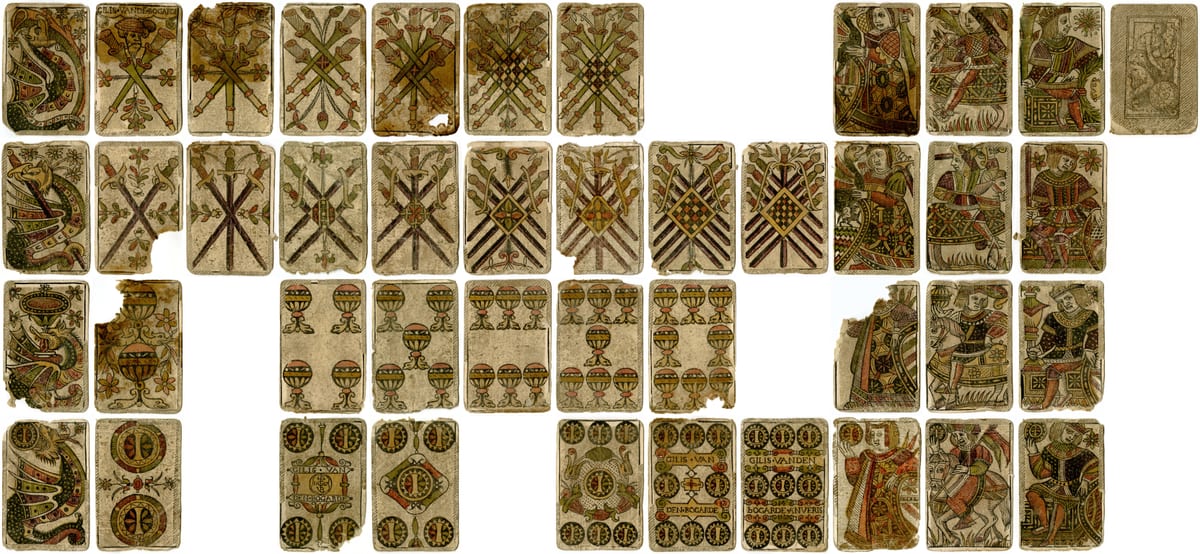
The best-known centre of production was Miike in Chikugo Province, today the city of Ōmuta in Fukuoka Prefecture. The oldest surviving Japanese-made card, a single Tenshō karuta kept at the Tekisui Museum of Art in Ashiya, carries the inscription 三池住貞次, “Sadatsugu, living in Miike”, on its back. Card making later moved to Kyoto, the great market, but writings of the time still said that “the good ones come from Miike”.[1] In 1991 Ōmuta opened a museum devoted to karuta, which it describes as the only one of its kind in Japan; merged with the city’s history museum in 2006, it is now the Miike Karuta and History Museum.[4][5]
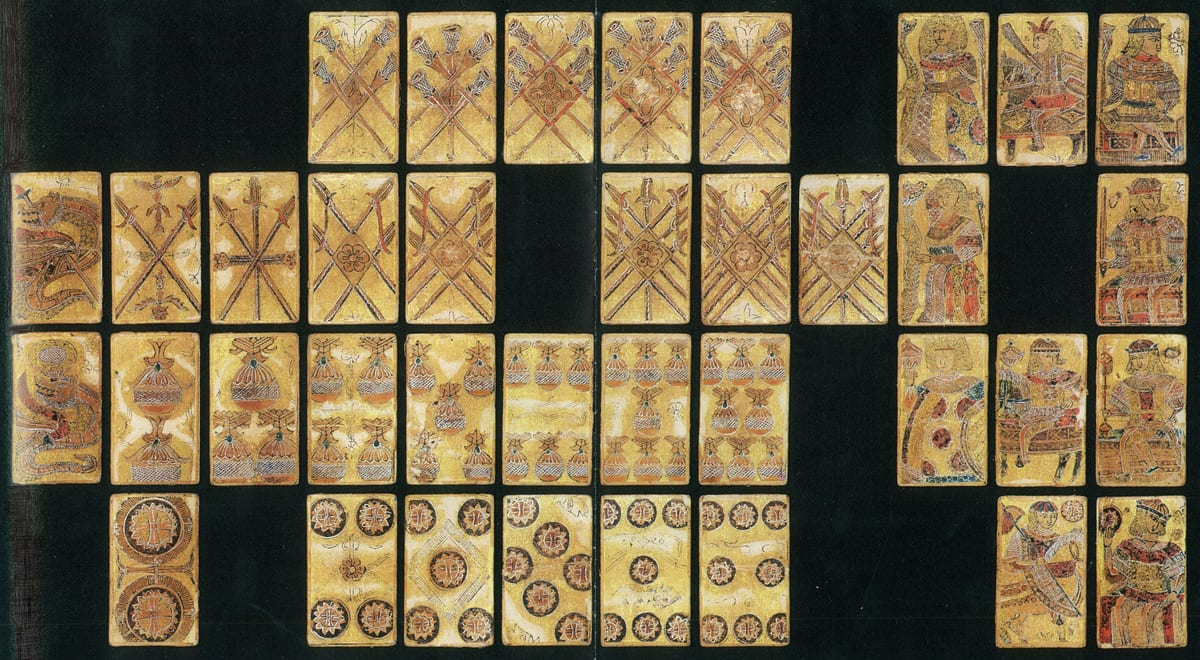
The 48 cards of today’s hanafuda are widely seen as an echo of that first Portuguese pack.[6]
Unsun karuta: cards become Japanese
As card play spread, Japanese makers enlarged the deck. Unsun karuta (うんすんカルタ) had 75 cards in five suits of fifteen, with new court figures such as Un, a god of good fortune, and Sun, a Chinese man; it is documented from 1681.[7] The game faded almost everywhere, but a local tradition kept it alive in Hitoyoshi, Kumamoto, and in 1965 its play was designated an Important Intangible Folk Cultural Property of Kumamoto Prefecture. Older books claimed that Tenshō karuta descended from Unsun karuta; in fact it was the other way round.[7]
Nintendo’s own short history of hanafuda follows the same line: from Tenshō karuta at the end of the 16th century and Unsun karuta in the early Edo period to the deck we use today, which, it says, took shape in the middle of the Edo period.[8]
Bans, disguises and the first flower cards
Karuta soon became a gambling tool, and the Tokugawa shogunate answered with one ban after another. An Edo town ordinance outlawed card gambling in 1648, and similar orders followed again and again.[2][3] Gamblers moved from game to game and from design to design: first yomi, then mekuri karuta, which was hugely popular from the 1760s and was hit by a crackdown in the mid-1770s.[2] During the Kansei Reforms (1787–1793), an Edo ordinance of 1791 banned the sale of cards “used only for gambling”, naming the kinko, yomi and mekuri packs.[9]
The classic account: a disguise
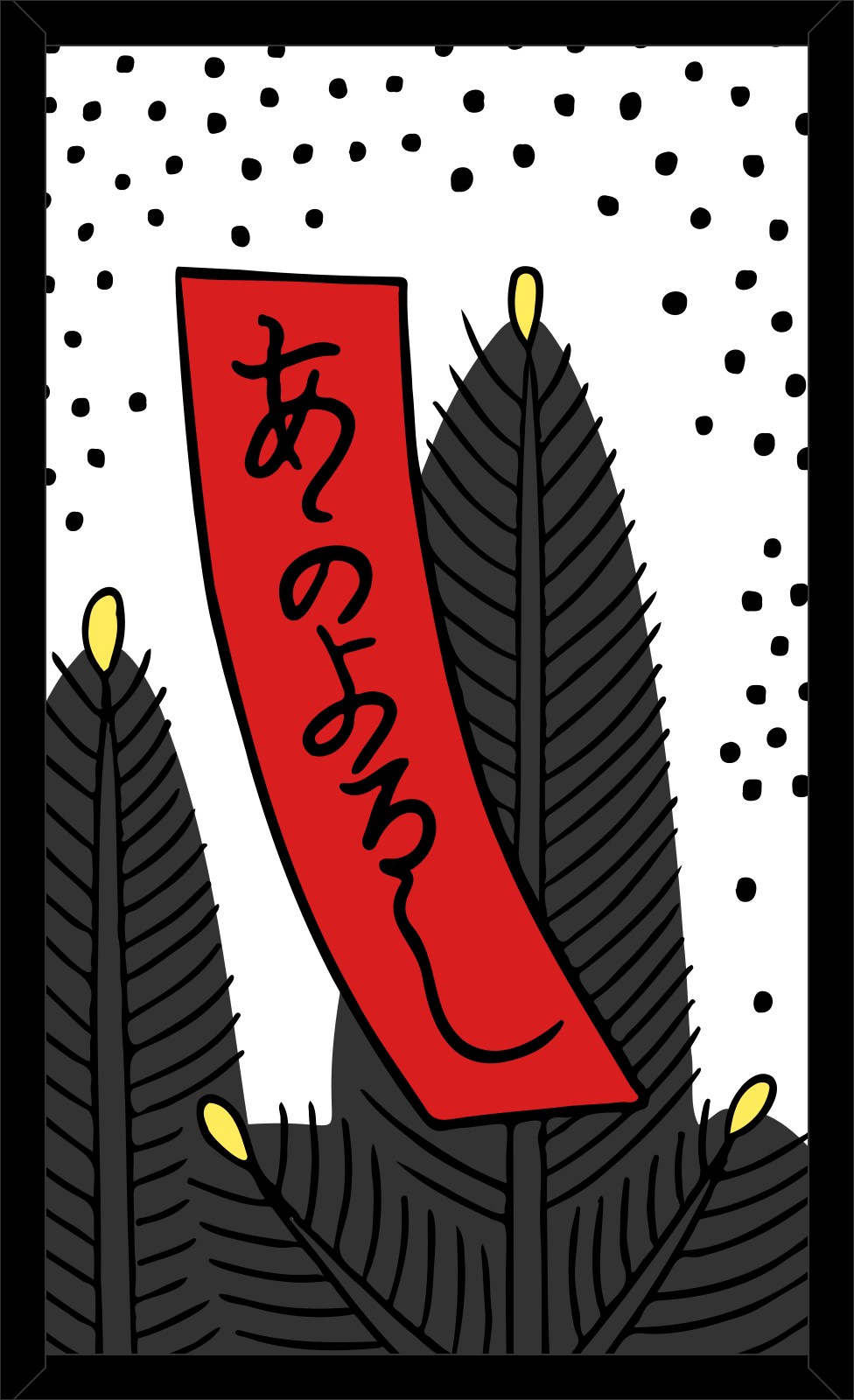
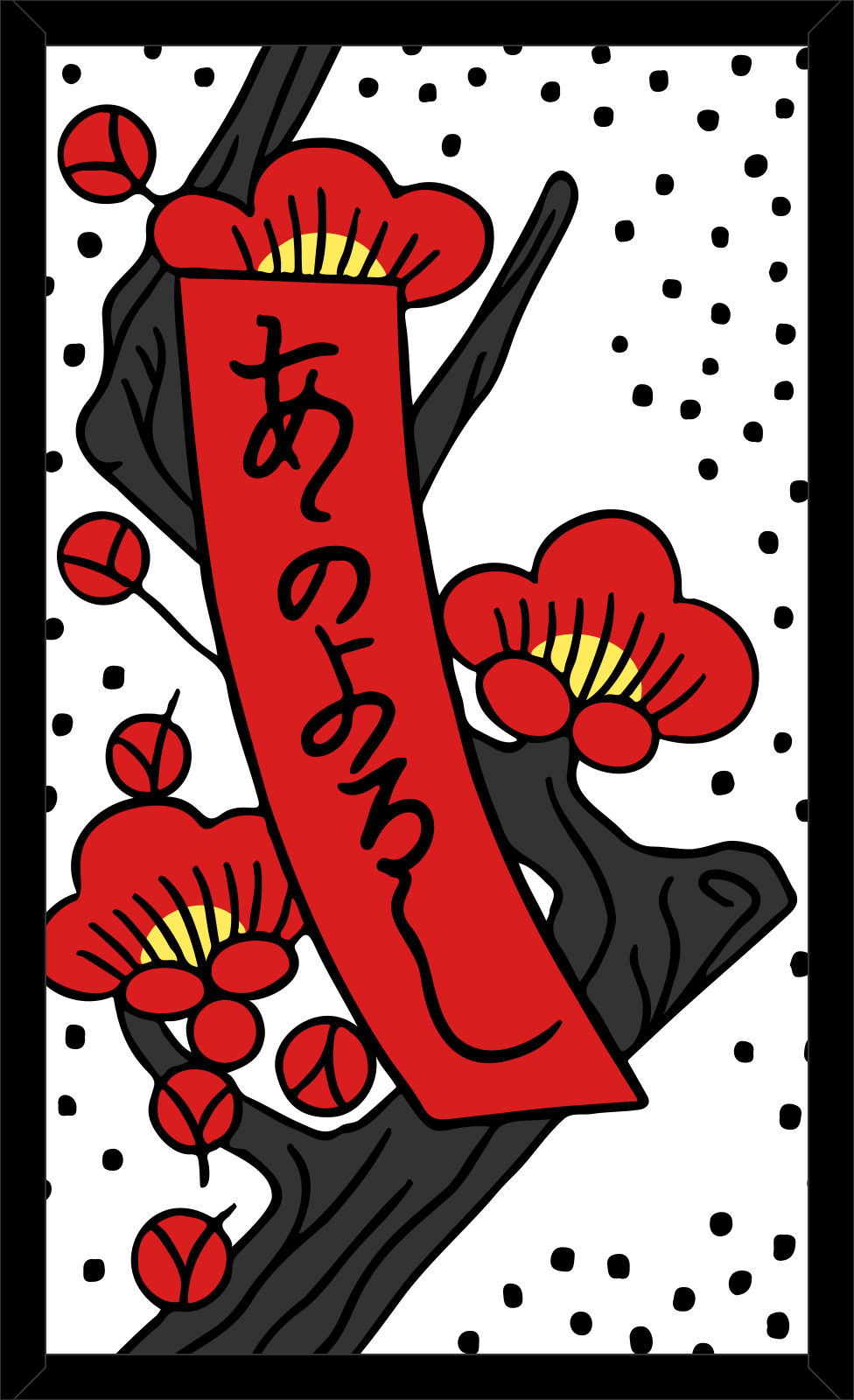
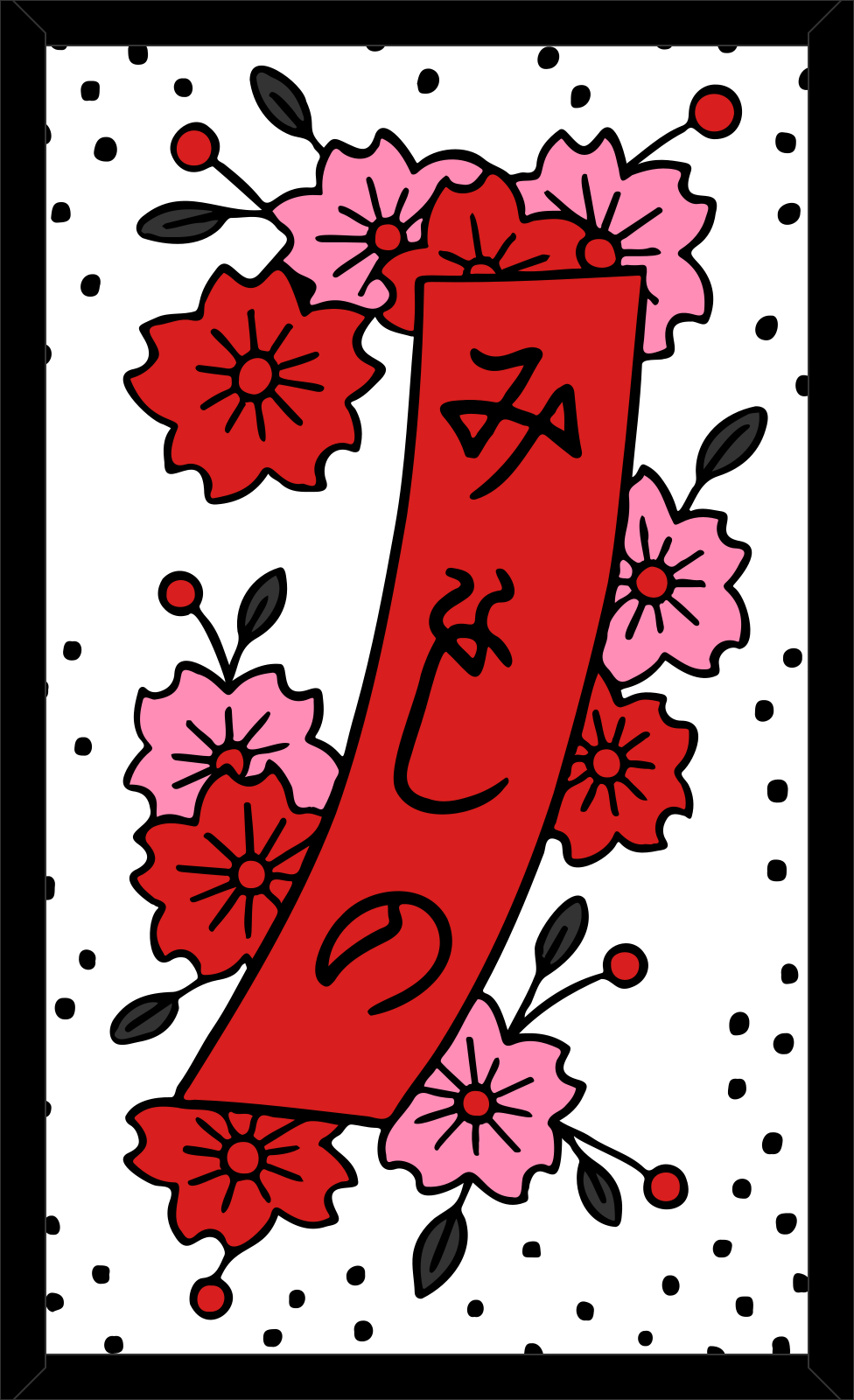
Poem cards such as the Hyakunin Isshu, by contrast, were seen as educational and stayed legal. That is the root of the classic account of hanafuda’s birth. To get around the Kansei ban, makers kept the 48-card structure of the gambling packs, replaced the suits with the flowers of the twelve months, borrowed from genteel flower-and-bird matching cards, and wrote classical verses on some cards so that they would pass as poetry cards.[3][10] The poem strips (tanzaku) on today’s cards are often read as a relic of that disguise.
The newer view: an elegant pastime first
Recent research complicates the story. The card historian Ebashi Takashi, director of the Japan Playing Card Museum, points to luxurious flower-matching sets that high-born women played around 1700 as an elegant pastime. One surviving set, attributed to the court painter Tosa Mitsunari, has a hundred flowers of four cards each, 400 cards in all.[12] In Ebashi’s reading, a twelve-month, 48-card form had emerged by the Kyōhō era (1716–1736), and a woodblock-printed flower deck called Musashino was on sale some twenty years before the Kansei Reforms. Hanafuda, he concludes, was not invented as a substitute for banned gambling cards, even though it was soon used for the same games.[12][13][14] Other writers date the Musashino deck to the 1770s–1790s and still see it as a stand-in for mekuri cards.[2]
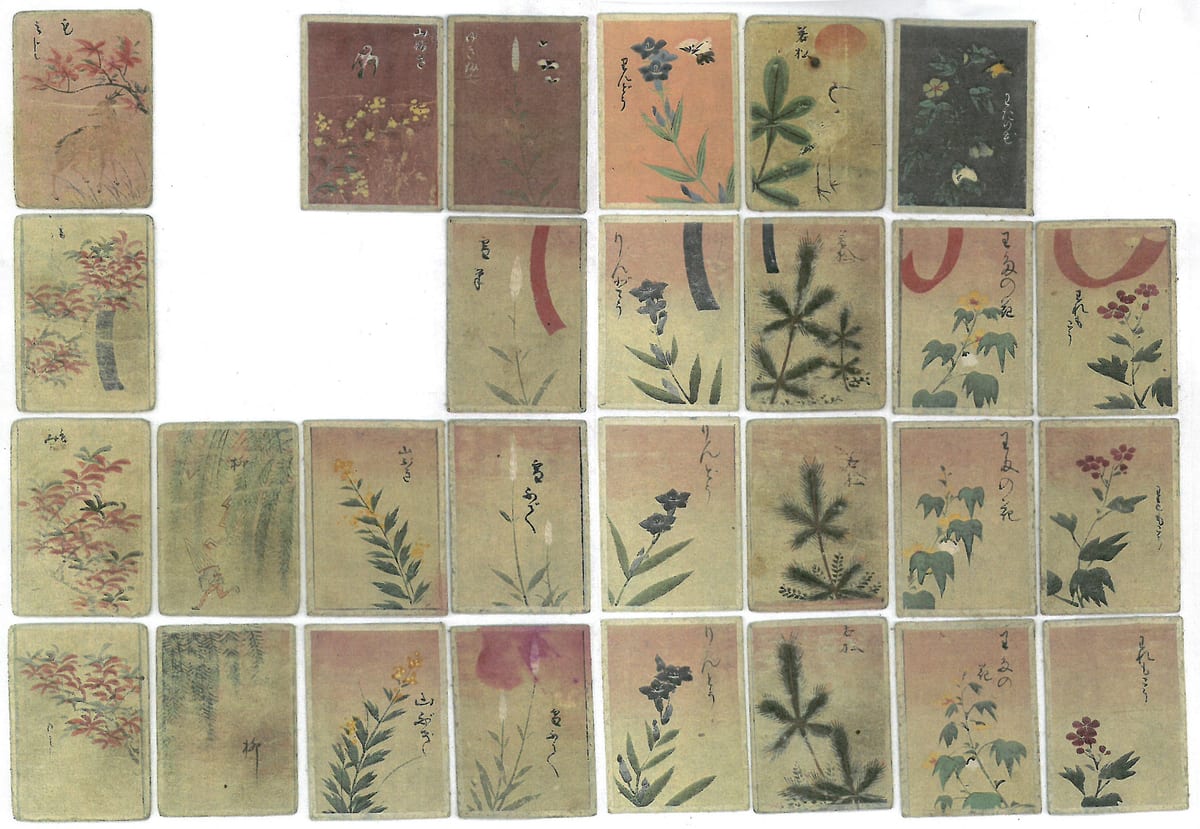
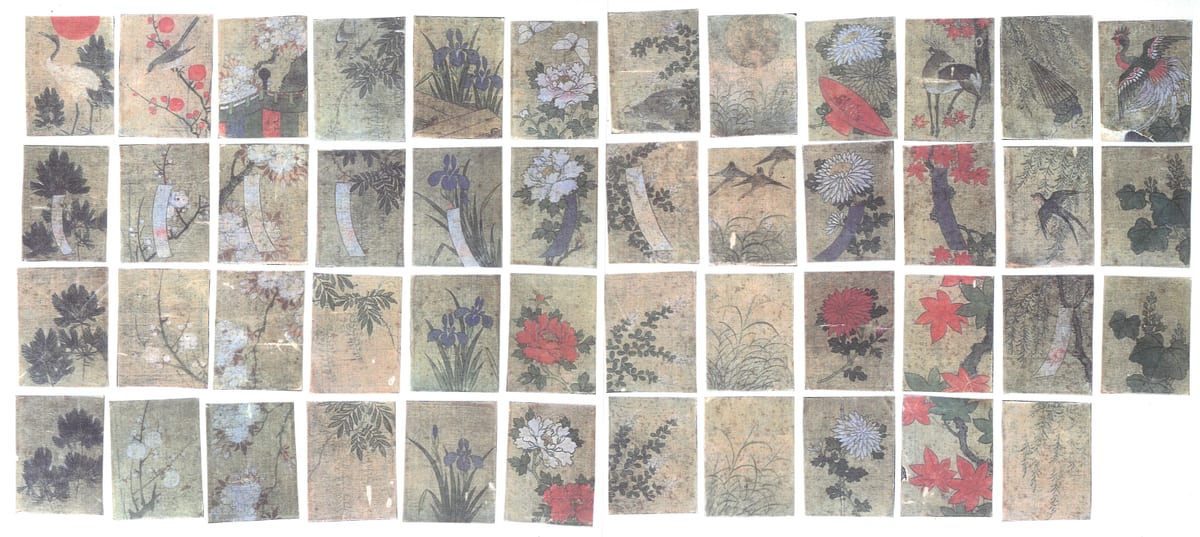
Historians still debate the details. What is certain is that 48-card flower decks were circulating by the late 18th century and that officials were banning them by name in the 19th: an 1831 notice told the headmen of Shinagawa and the Yoshiwara not to buy flower cards, “easily confused with mekuri cards”, and a Kyoto ordinance of 1842 warned against betting on hana-awase.[6]
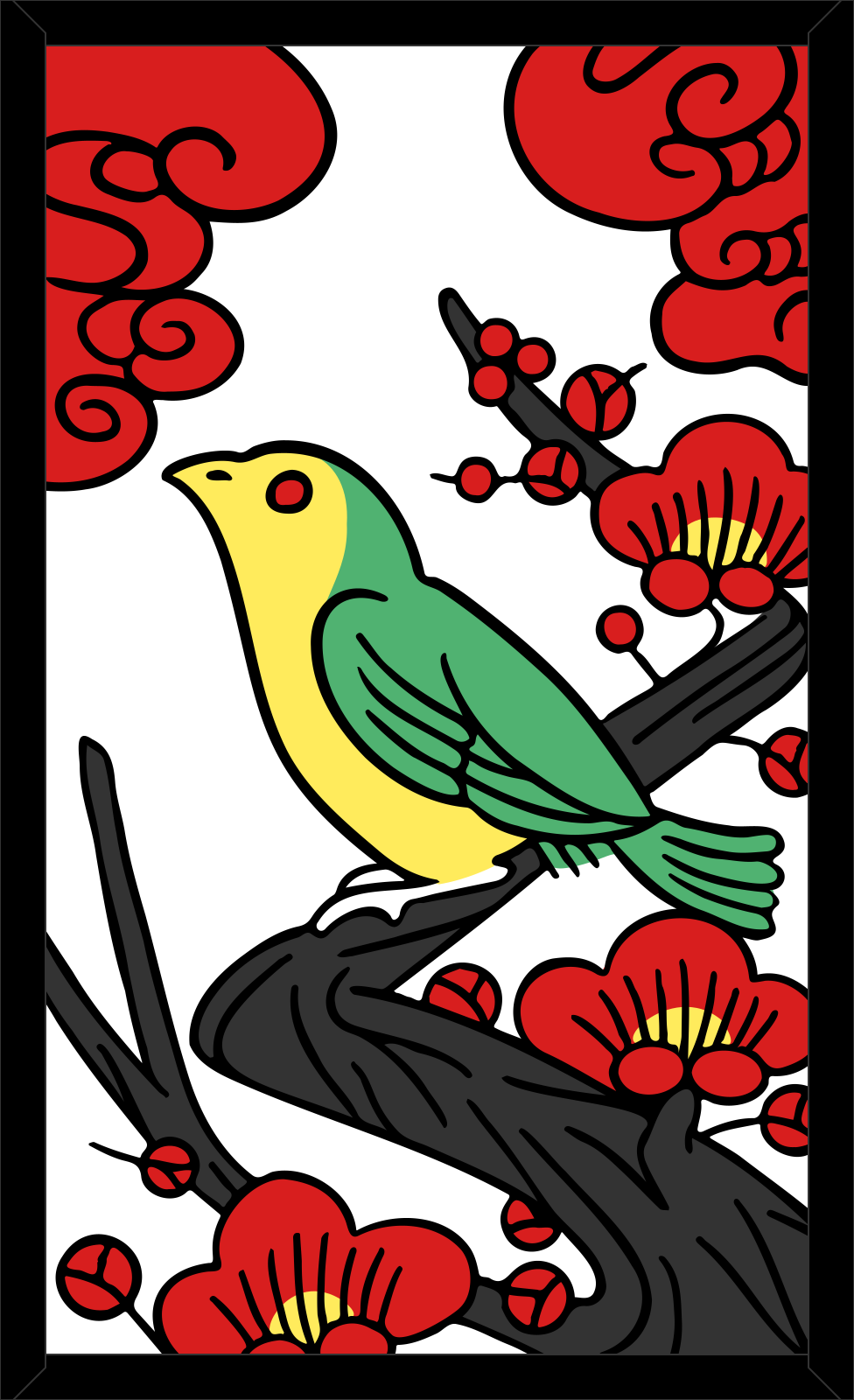
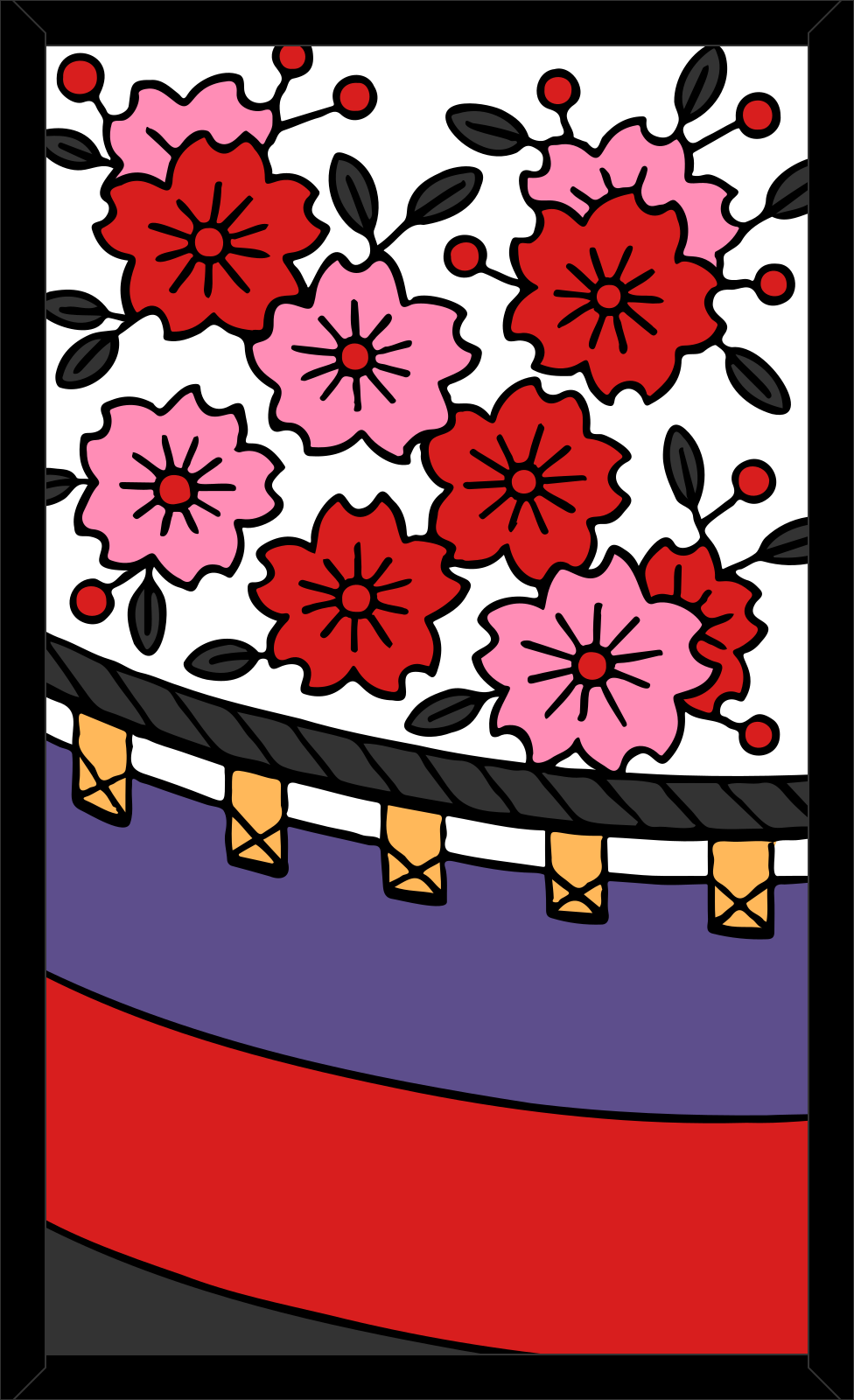
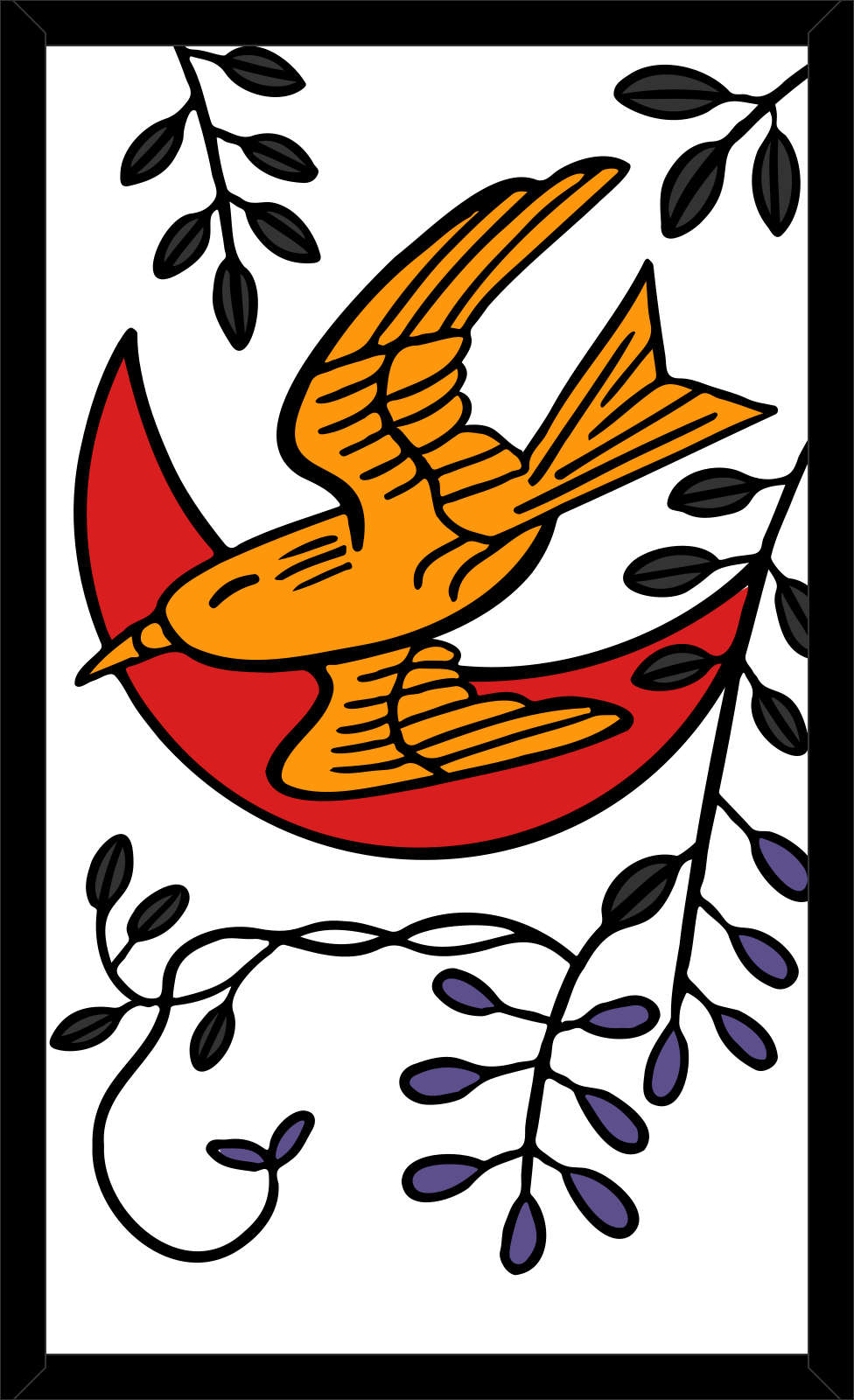
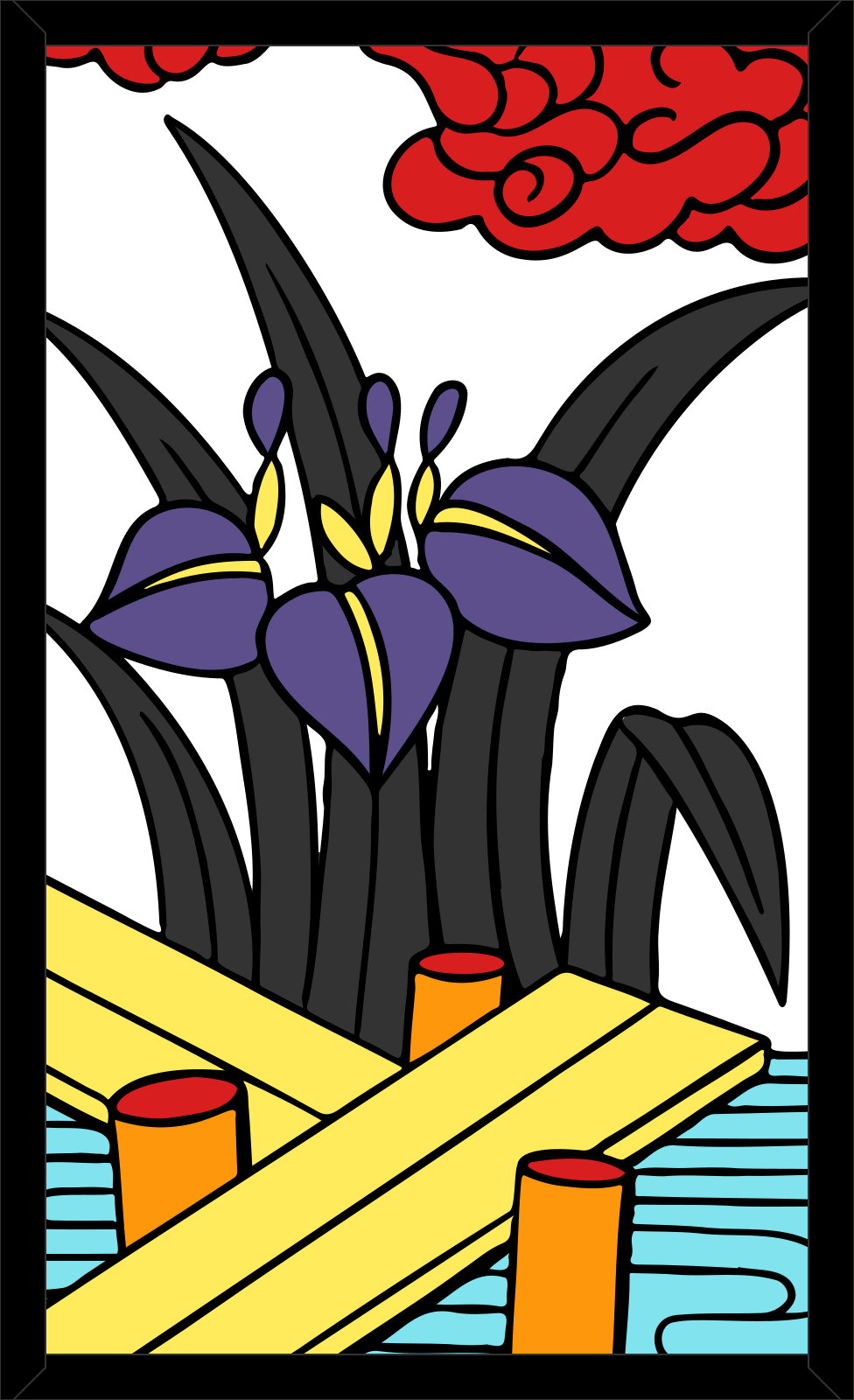
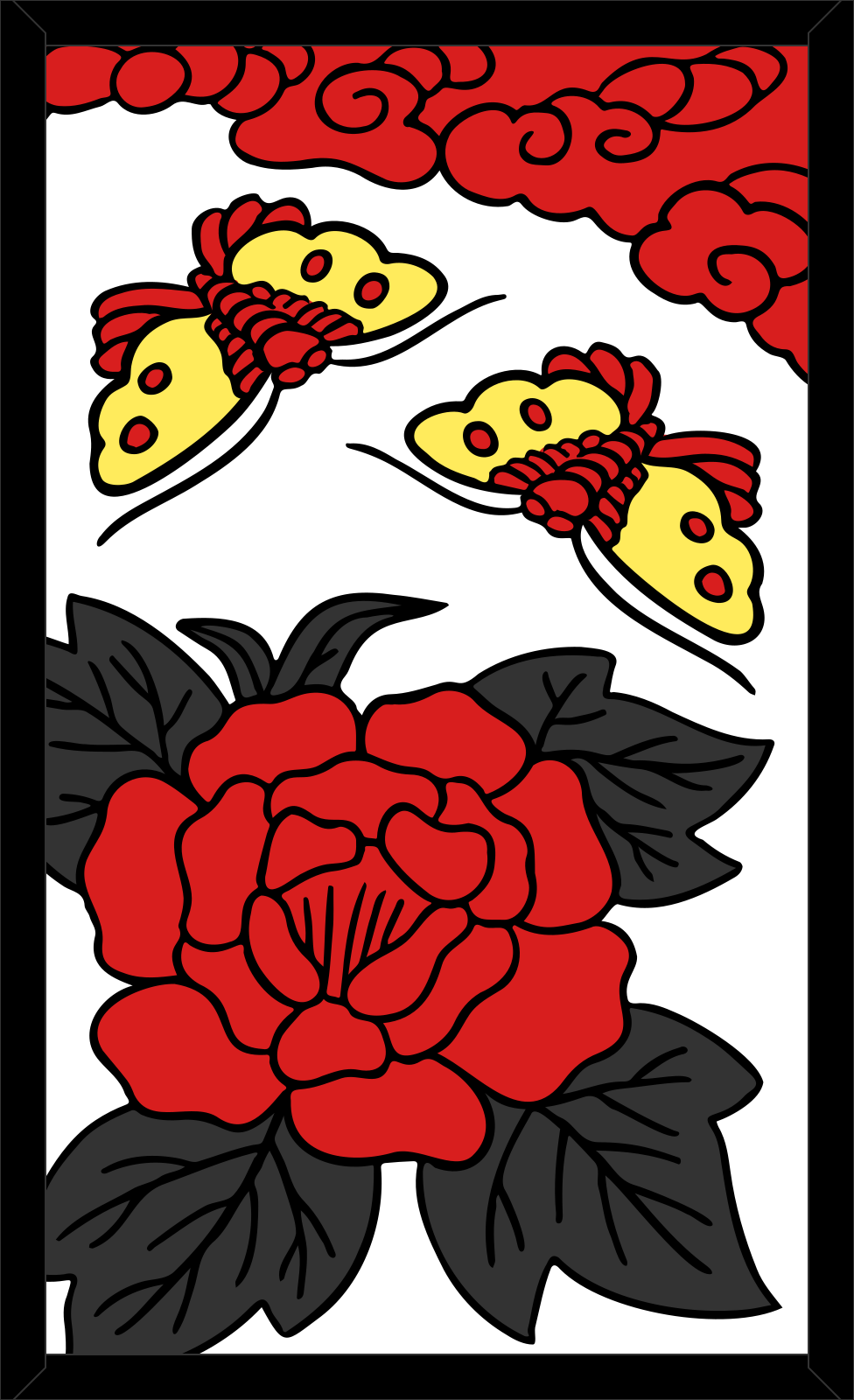
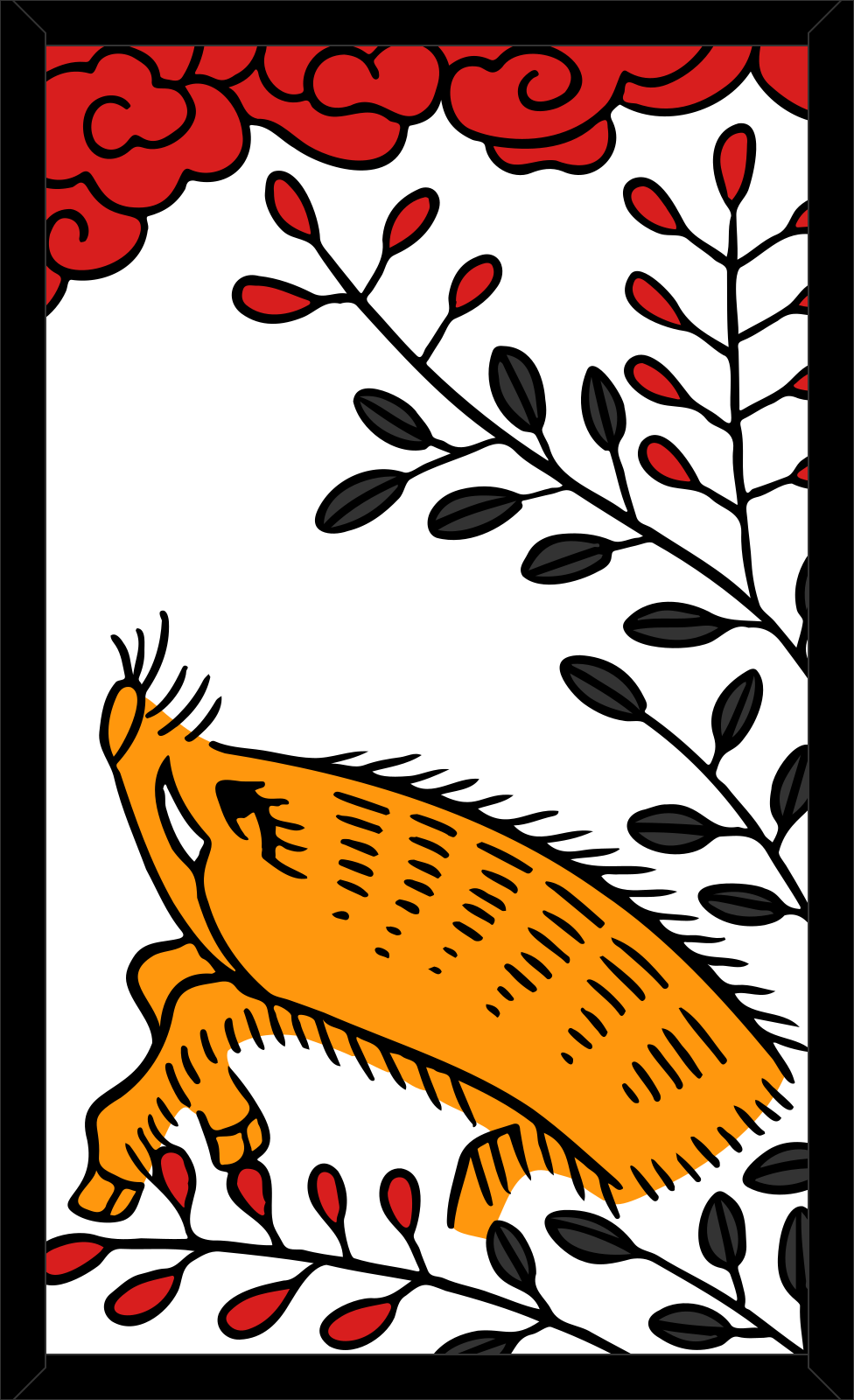
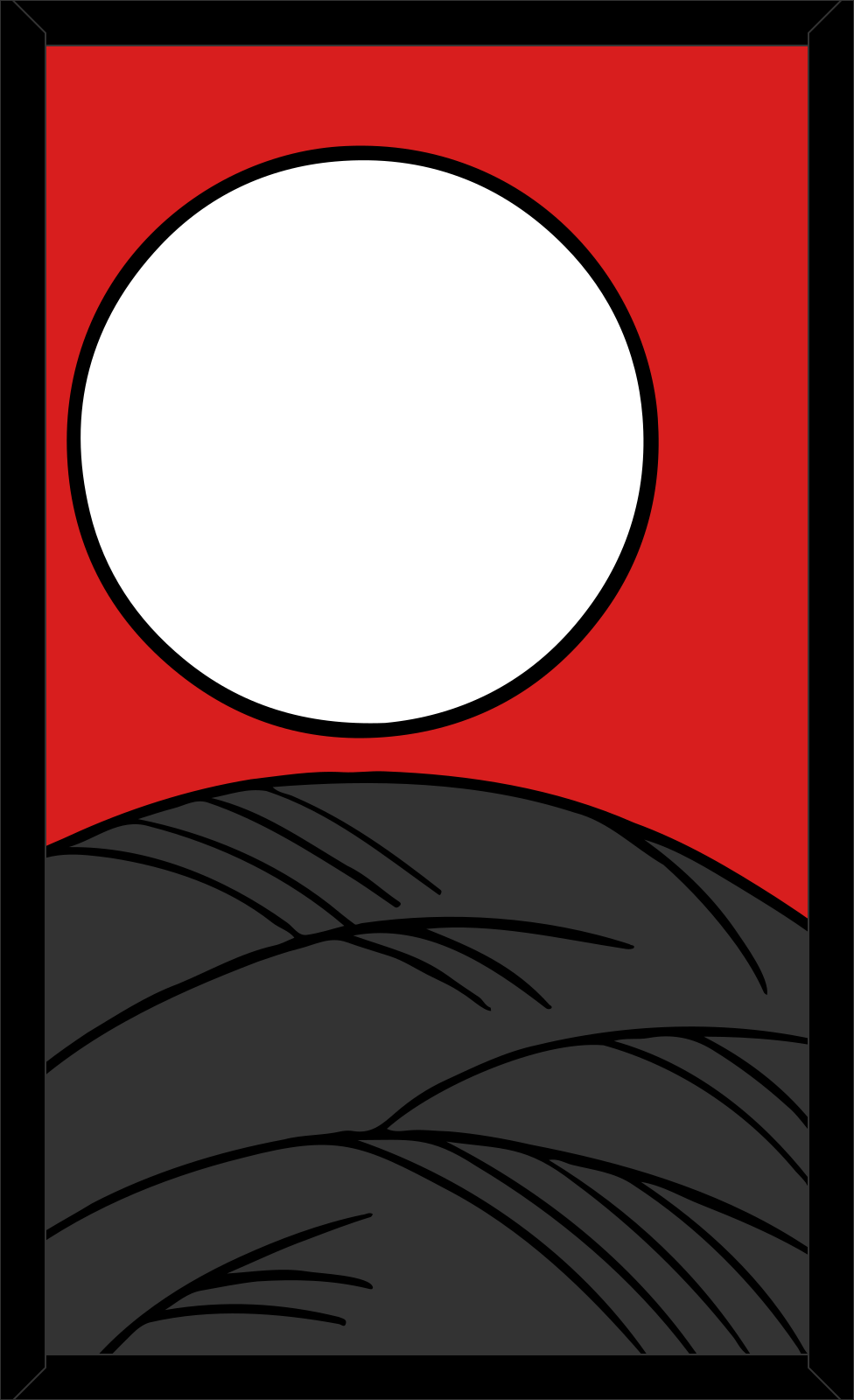
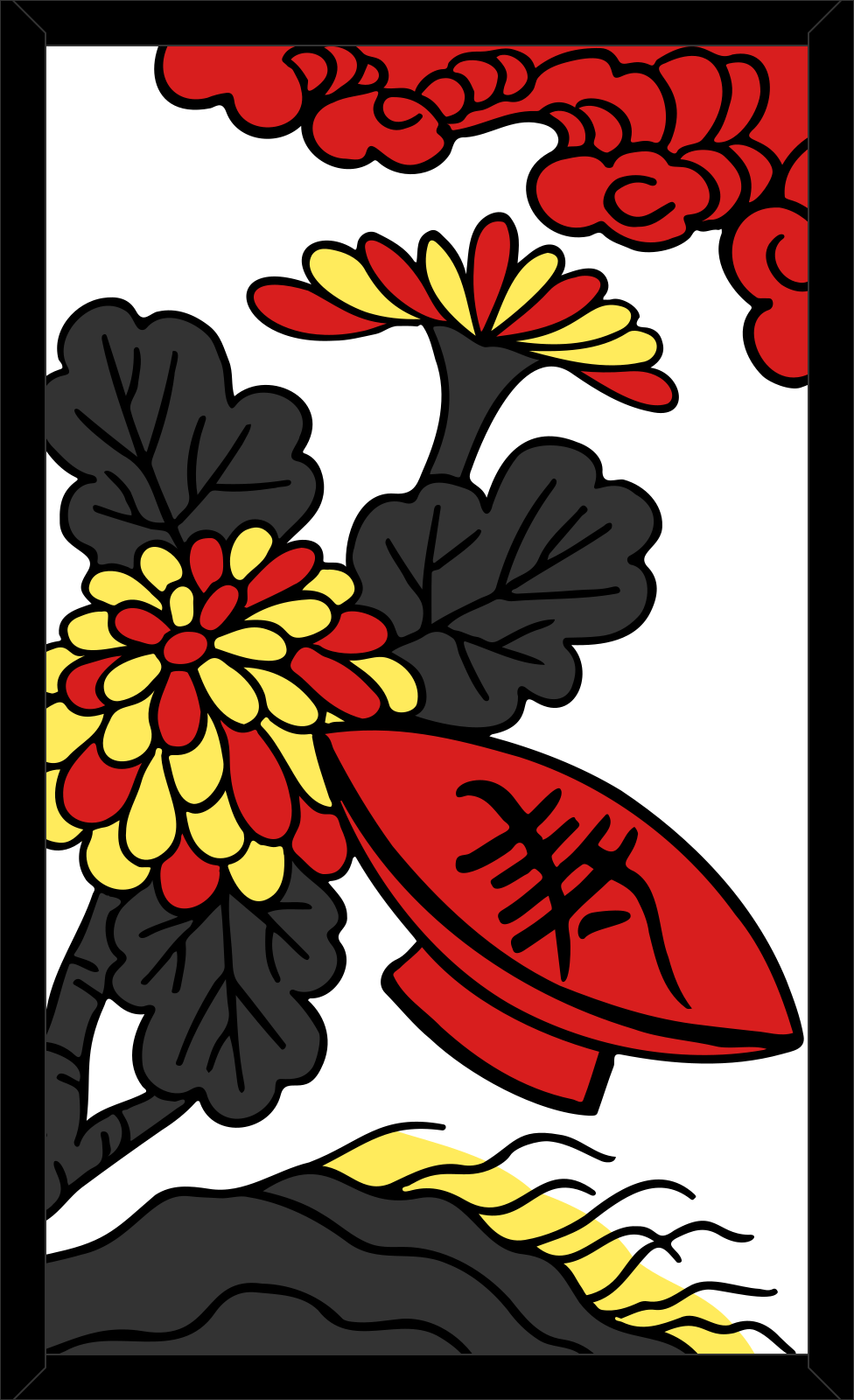
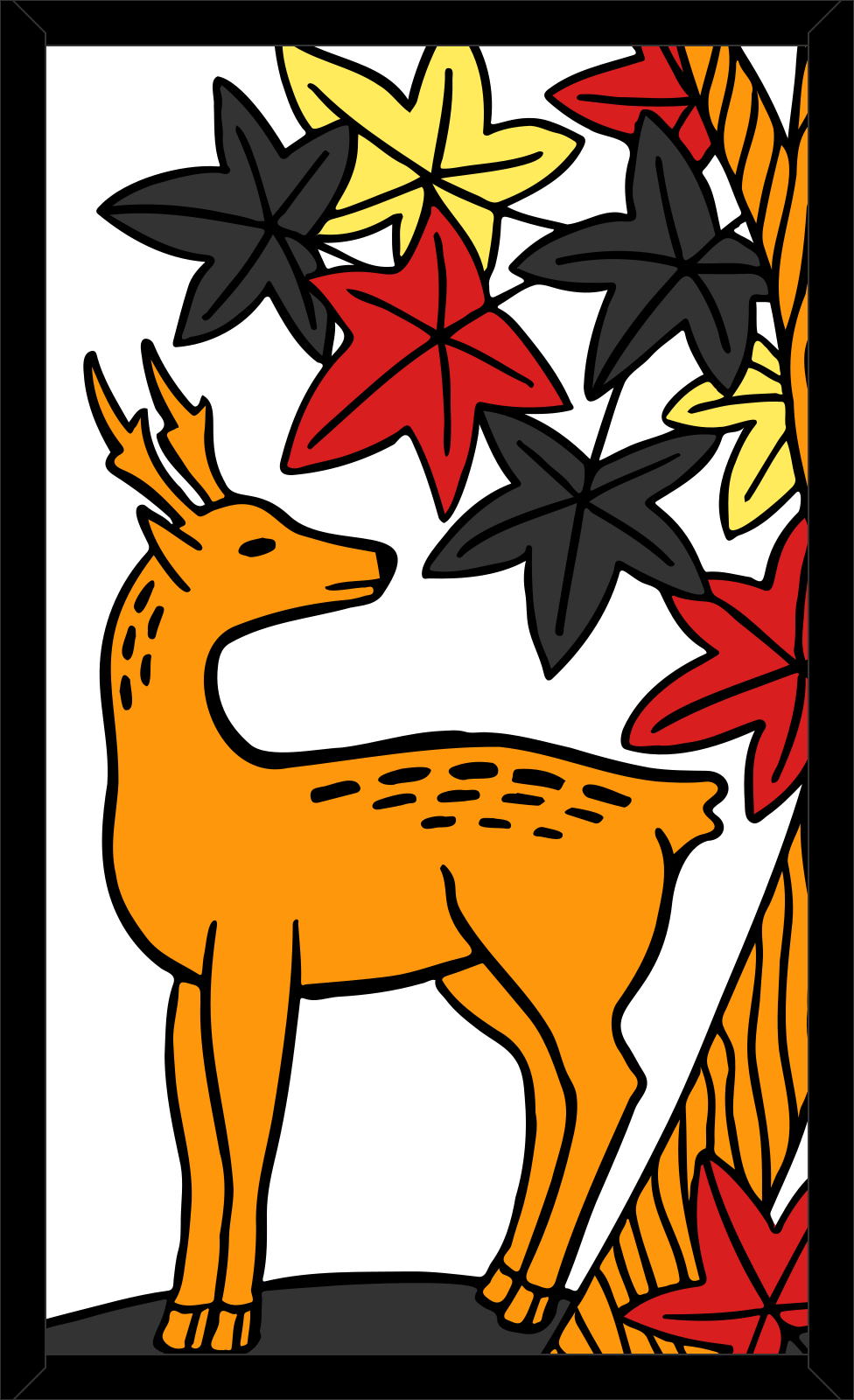
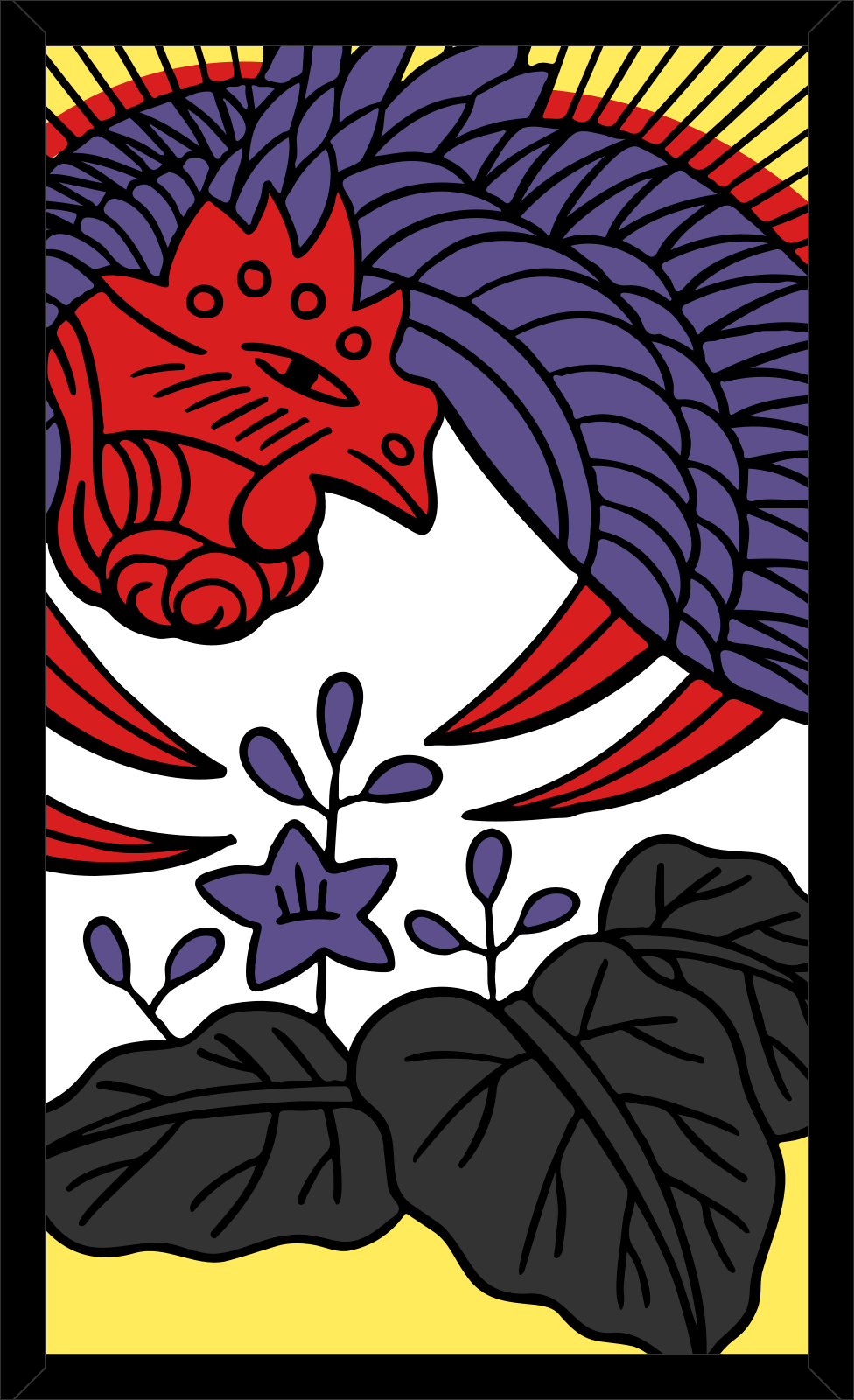
_-_sorted.jpg)


The early name Musashino evoked the great plain west of Edo, famous in poetry for a sea of pampas grass from which the moon seemed to rise and into which it set.[15] That image lives on in the August card, the Moon (芒に月, susuki ni tsuki, “moon over pampas grass”), the eighth card from January in the figure above.
Meiji: legal at last
The new Meiji government at first kept the ban, but the Penal Code that took effect on 1 January 1882 no longer mentioned flower cards.[6] In November 1885 the Osaka merchant Maeda Kihei notified the Home Ministry that he would sell flower cards from a new shop in Kyōbashi, Tokyo, and by 1886 open sale was accepted.[6][16]
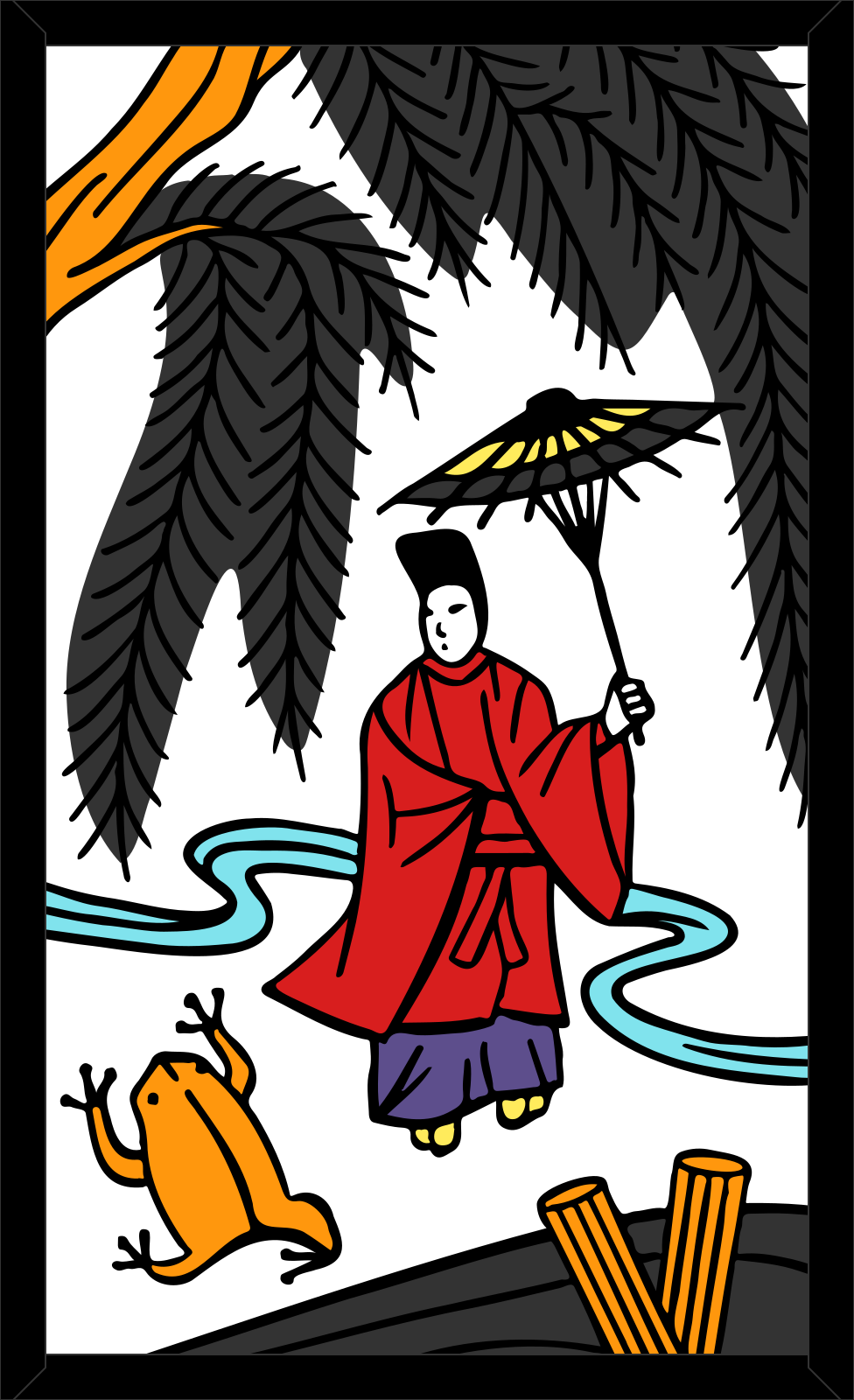
Maeda is also credited with a small but lasting redesign. Around 1886, it is said, he persuaded the makers to redraw the figure on the November Light card and so give the cards a more respectable image: a rain goblin that people took for Sadakurō, the robber of the kabuki play Chūshingura, became the Heian-period calligrapher Ono no Michikaze (894–966).[6][17] Legend has it that Michikaze, discouraged, watched a frog leap again and again at a willow branch until it caught it, and went back to his brush. The frog is still on the card.[18]
A three-player game called hachi-hachi (“eighty-eight”) swept the country, and the clear, bold deck made for it, hachi-hachi-bana, became the national standard in the 1890s.[6][10] Flower cards became a fashionable pastime among the elite, so fashionable that in 1892 the Chief Justice of the Great Court of Cassation, Kojima Iken, and other senior judges were accused of gambling at hanafuda with geisha. The disciplinary case against them was dismissed, but the scandal ended with Kojima’s resignation.[6]
Alongside the standard deck, regional patterns (chihō-fuda) flourished: Echigo-bana in Niigata, Hokkai-bana in Hokkaido, Bizen-bana in Okayama, Awa-bana (or Kintoki-bana) in Tokushima, and Yamagata-bana and Hanamaki-bana in the north-east, among others. Most were in fact printed in Kyoto, and nearly all had disappeared by the early Shōwa era, which began in 1926.[6][10]
Nintendo and the card makers of Kyoto
In 1889 Fusajirō Yamauchi began making hanafuda in Shimogyō-ku, Kyoto.[19] That workshop became Nintendo. Histories in English give the founding date as 23 September 1889 and the early name as Nintendo Koppai.[20] Nintendo’s own timeline says it began making Western-style playing cards in 1902, the first in Japan to do so. It also records that the present company, set up in 1947, was renamed 任天堂骨牌 (Nintendo Koppai) in 1951 and took its current name, Nintendo Co., Ltd., in 1963. Koppai (骨牌) meant cards and mahjong tiles, the same word that named the card tax below.[19][21]
Nintendo still sells hanafuda, among them decks under the Daitōryō (“President”) and Fuku Tengu brands and Mario-themed decks.[22] The name Nintendo is often said to mean “leave luck to heaven”, but there is no firm historical evidence for that reading.[20][23]
Together with older houses such as Ōishi Tengudō, founded in 1800,[24] these firms made Kyoto the centre of Japanese card making. A 1965 survey of the prefecture’s industries is reported to have put the city’s share of Japan’s card production at more than 95 per cent.[6]
This site is not affiliated with Nintendo or any card maker.
The 1902 card tax
On 5 April 1902 Japan promulgated the Playing Card Tax Law (骨牌税法, koppai-zei hō), which came into force on 1 July.[16] It taxed karuta, hanafuda, Western playing cards and mahjong tiles; cards were then regarded as a luxury. Every pack had to carry a 20-sen tax stamp, each factory was charged 60 yen, and manufacture needed a licence; unlicensed makers faced fines of 300 to 1,000 yen. According to Japan’s National Tax Agency, it was one of several new taxes, sugar among them, introduced when the foreign bond issues that had carried state finances since the Sino-Japanese War of 1894–95 stalled.[21]
The effect on the trade was drastic. Yamauchi himself, as head of the Kyoto card makers’ association, is reported to have counted about 40 makers in the city around 1898 and 11 once the tax took effect.[6] Small regional makers closed, the regional patterns withered, and production concentrated in a few firms in Kyoto and Osaka.[6][16] The tax was renamed in 1957 and abolished in 1989, when Japan introduced its consumption tax.[21] With the licences gone, anyone could print hanafuda, and decks with every kind of theme followed.[6]
Hanafuda abroad
Flower cards travelled with Japan’s soldiers, settlers and emigrants. They reached Korea in the 1890s: Ebashi links their spread to Japanese troops in the Sino-Japanese War of 1894–95, and by the Taishō era (1912–1926) demand in Korea exceeded demand in Japan.[3][25] Known as hwatu (花闘, “flower battle”), they remain a national pastime in South Korea. The cards are usually plastic, the November and December suits change places, and the favourite game, Go-Stop, a close relative of Koi-Koi, appeared in the 1960s and became hugely popular from the 1970s.[3][26][27]
In Hawaii, where Japanese contract immigration began in 1885, hanafuda arrived with plantation workers. Many of them came from Kumamoto, the old province of Higo, and their game became the Hawaiian favourite Sakura, also called Higobana.[6][28][29] In Palau, under Japanese administration after the First World War, the cards are still played as hanahuda, often by two teams of two.[6][28]
Koi-Koi: a twentieth-century game
Koi-Koi (also written koi koi or koikoi) is a game for two. Players match a card from their hand, then a card turned from the draw pile, with a card of the same month on the table, and race to form scoring combinations called yaku. When a turn ends with a new yaku, its player may stop and score (Shōbu, shobu) or call “Koi-Koi” and play on for more, at the risk that the opponent scores first. The name comes from that call: koi (来い) means “come on!”.[3][30]
By hanafuda standards Koi-Koi is young. A dictionary of yakuza slang, Yakuza jiten, says it caught on in Tokyo from about 1925. Hanzawa Torakichi, a pre-war Kanagawa police detective who investigated gambling, wrote that it came from the Aizu region of Fukushima, reached Tokyo around 1928 and was played as a warm-up before the serious betting.[31][32][33] Both accounts come from the world of gambling and are hard to verify. Koi-Koi is said to have become widely known around 1950 and its rules to have first appeared in a book in 1958, a paperback of fifty card games; Nintendo’s decks are reported to have come with a leaflet of “modern Koi-Koi” rules since about 1994.[33][34]
The older three-player games, hachi-hachi and hana-awase, add up the values of the cards you capture (20, 10, 5 and 1 points). Koi-Koi ignores those values and scores yaku alone.[33] Quick to learn and full of bluff, it became the usual game for two, and Nintendo calls it “the most famous way to play hanafuda”.[8] Its link with Korea’s Go-Stop runs both ways: Go-Stop plays much like Koi-Koi, while Ebashi argues that modern Koi-Koi rules in turn borrowed partly from Go-Stop.[26][33]
Hanafuda in modern pop culture
Mamoru Hosoda’s animated film Summer Wars (2009) builds its climax around a game of Koi-Koi: the heroine, Natsuki, plays a rogue AI with the accounts of people all over the world at stake.[37][38] Nintendo has put Koi-Koi in its Clubhouse Games collections for Nintendo DS (2005–06) and Nintendo Switch (Clubhouse Games: 51 Worldwide Classics, 2020).[33][39] In October 2024 it opened the Nintendo Museum in Uji, Kyoto, in its former Uji Ogura plant, where playing cards and karuta were made from 1996 to 2004; visitors can make their own hanafuda there and try a flower-card game.[8][40][41]
Koi-Koi is a recurring gambling-den minigame in Sega’s Yakuza / Like a Dragon series.[42][43] And the “hanafuda earrings” worn by Tanjirō in Demon Slayer show how familiar the look of the cards remains, even though their design is not an actual hanafuda card.
From Edo parlours to your browser
More than four centuries after the first Portuguese cards arrived, hanafuda are still a small encyclopaedia of the Japanese year: New Year pines and plum blossom, cherry-viewing and the autumn moon, chrysanthemum sake and maple leaves, with poems and legends woven into the pictures. Koi-Koi, quick to learn and played by two, is a good way to get to know them.
On this site you can play it in the browser: practise against the computer without an account, or sign in with Google and invite a friend to a room. What is hanafuda? describes the deck, and all 48 cards are shown month by month.
Sources
- カルタと大牟田の歴史. Ōmuta City Miike Karuta and History Museum: Karuta and the history of Ōmuta: the Portuguese cards, Miike, the oldest surviving card.
- 天正かるた. Wikipedia (Japanese): Tenshō karuta; quotes the Edo ordinances against card gambling.
- Hanafuda. Wikipedia
- 当館について. Ōmuta City Miike Karuta and History Museum: About the museum: opened in 1991, merged with the city’s history museum in 2006.
- 大牟田市立三池カルタ・歴史資料館. City of Ōmuta: The museum, formed by the 2006 merger of the karuta museum and the city history museum.
- 花札. Wikipedia (Japanese): Hanafuda; quotes primary sources held by the National Diet Library.
- うんすんカルタ. Wikipedia (Japanese): Unsun karuta.
- 歴史・遊びかた|花札・株札. Nintendo: Nintendo’s short history of hanafuda and its ways to play.
- (二)寛政の改革によるカルタ博奕の禁制. Japan Playing Card Museum (director: Ebashi Takashi): The Kansei Reforms’ ban on card gambling.
- 花札. Murai Shōzō, Heibonsha World Encyclopedia (Kotobank): Encyclopaedia entry on hanafuda.
- 花札の謎シリーズ! 赤短『あかよろし?』. Ōishi Tengudō, Kyoto card maker (blog): What “akayoroshi” on the red poem ribbons may mean.
- (二)花合せかるたの百紋標の内容. Japan Playing Card Museum (director: Ebashi Takashi): The hundred-flower matching cards of around 1700.
- (三)木版花札「武蔵野」の登場. Japan Playing Card Museum (director: Ebashi Takashi): The woodblock-printed “Musashino” flower deck.
- 花札(ものと人間の文化史 167). Ebashi Takashi, Hōsei University Press (2014): A book-length history of hanafuda (National Diet Library catalogue entry).
- (四)「武蔵野」という名称の由来. Japan Playing Card Museum (director: Ebashi Takashi): Where the name “Musashino” comes from.
- 一.骨牌税法の制定. Japan Playing Card Museum (director: Ebashi Takashi): The Playing Card Tax Law of 1902 and the Meiji legalisation.
- 花札の謎シリーズ!11月札『柳に小野道風(おののとうふう)』. Ōishi Tengudō, Kyoto card maker (blog): The November card and the figure it replaced.
- 小野道風. Wikipedia (Japanese): Ono no Michikaze and the legend of the frog.
- 会社の沿革. Nintendo: Nintendo’s company history: 1889, 1902, 1947, 1951, 1963.
- Nintendo. Wikipedia: History section (cites Sheff 1999 and Gorges 2015).
- 一杯一杯の財政とこっぱい税(答え). National Tax Agency, National Tax College: The card tax of 1902: what it charged and why it was introduced.
- 花札・株札. Nintendo: Nintendo’s current hanafuda: Mario, Daitōryō, Fuku Tengu, Miyako no Hana.
- “Nintendo” Probably Doesn’t Mean What You Think It Does. Brian Ashcraft, Kotaku
- 京都大石天狗堂. Ōishi Tengudō: The maker’s site: founded in 1800.
- (二)植民地朝鮮における花札の流行. Japan Playing Card Museum (director: Ebashi Takashi): Hanafuda in Korea under Japanese rule.
- Go-Stop. Wikipedia: Cites Ebashi (2014) and the National Folk Museum of Korea.
- Encyclopedia of Korean Seasonal Customs. National Folk Museum of Korea (2014): p. 103: Go-Stop.
- Games played with Flower Cards. John McLeod, pagat.com
- Hanafuda – Hawaii style. West Hawaii Today (5 February 2012)
- こいこい. Nihon Kokugo Daijiten and Digital Daijisen (Kotobank): Dictionary entries: where the name comes from.
- やくざ事典. 井出英雅, National Diet Library Digital Collections: A dictionary of yakuza terms: Koi-Koi in Tokyo from 1925.
- 賭博:花札・さいころ・イカサマ手口. Hanzawa Torakichi, National Diet Library Digital Collections: Gambling, by a pre-war police detective: Koi-Koi from Aizu.
- こいこい. Wikipedia (Japanese): Koi-Koi: history, rules, appearances in games.
- トランプと花札 その遊び方五十種. Sports Shinsho, National Diet Library Digital Collections (1958): Fifty games for playing cards and hanafuda, with Koi-Koi rules.
- 花札の謎シリーズ!10月札『鹿に紅葉』. Ōishi Tengudō, Kyoto card maker (blog): The October deer and the word “shikato”.
- こいこい|花札の歴史・遊びかた. Nintendo: Nintendo’s Koi-Koi rules and yaku table.
- Summer Wars. Wikipedia
- 花札の謎シリーズ!『こいこい』って意外とあれなのね. Ōishi Tengudō, Kyoto card maker (blog): On Koi-Koi’s origins and Summer Wars.
- Nintendo Shares A Handy Infographic Featuring All 51 Worldwide Classic Clubhouse Games. Gavin Lane, Nintendo Life (25 May 2020)
- Nintendo Museum to open on October 2, 2024. Nintendo (news release) (20 August 2024)
- ニンテンドーミュージアム. Nintendo: The museum’s site, with the history of the Uji Ogura plant.
- Koi-Koi. Wikipedia: Koi-Koi in video games: the Yakuza series among others.
- Koi-koi Mini Game: How to Play and Win – Like a Dragon: Infinite Wealth. Game8